The Victory Train is on its way. Features of the mobile museum
Victory Day is still almost two months away, but the country is already preparing for this event. Museums present new expositions. Guides find interesting facts to surprise tourists. Railway workers also work hard. The mobile exhibition "Victory Train" is in unprecedented demand. As soon as the booking of tickets opens, they are immediately disassembled. What is special about this tour? Why is it interesting not only for the older generation, but also for young people? Let's figure it out.
Format
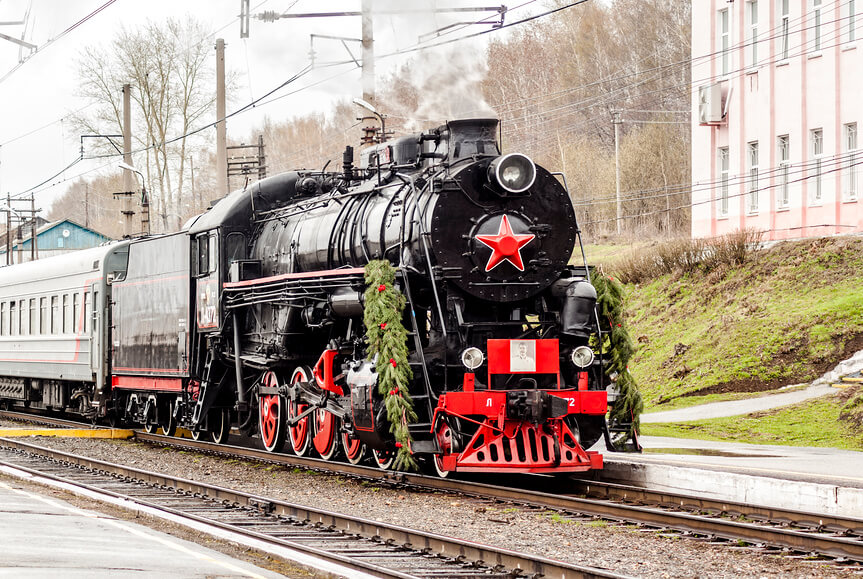
So, let's start with the fact that this is a real train. He moves along the rails from city to city. Stops at certain stations. Visitors have the opportunity to book an excursion in advance. The recording opens 1-2 days before the train arrives in the city. The tour takes 30 minutes. The interval between groups is only 5 minutes. Therefore, the organizers ask those who have purchased entrance tickets not to be late. It will not be possible to get inside with the next group. If for some reason a person has booked a ticket, but cannot attend the exhibition, they are asked to transfer this right to someone or inform the administration so that another person who wants to get to the exhibition gets this opportunity. There are usually more applicants than tickets. Therefore, you should not deprive another person of pleasure.
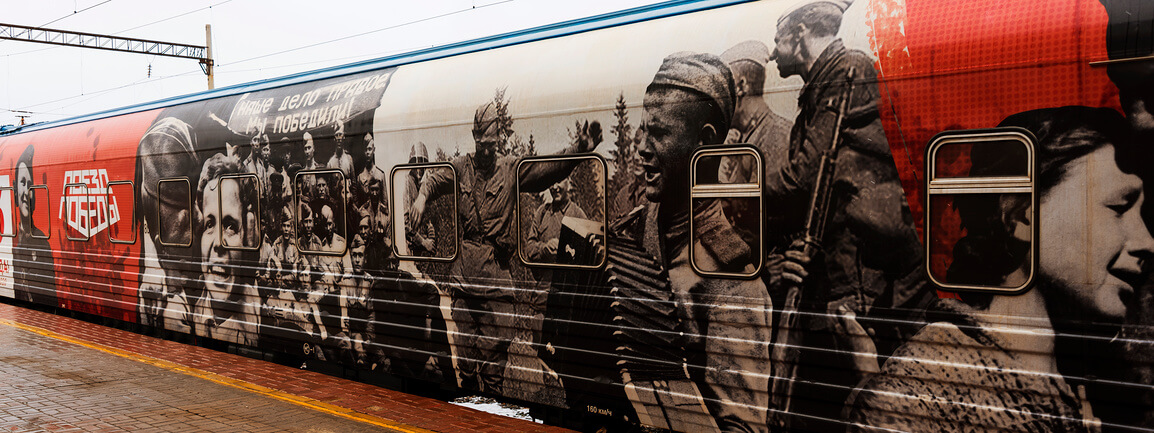
The train consists of 7 cars. Each of them is dedicated to a specific topic. But all of them directly relate to a period memorable for the whole country. 1941 – 1945. Fierce battles of the USSR against the Nazi invaders. By visiting the Victory Train, guests have the opportunity to immerse themselves in a unique atmosphere, feel these events with their hearts, and not just see them in a picture or read in a book. The Victory Train was created based on a story told by a veteran railroad worker. That is, the composition did not take direct part in the fighting, it only embodies that era. And quite successfully.
You can not only inspect the exhibits, but also touch them. Which, as a rule, you can't do in other museums. The effect of full immersion is facilitated by 50 video projectors, 18 video walls, 12 touch tables. Wartime items are presented to the attention of visitors. There are no more such a number of multi-figure compositions in any museum in the world. Guests find themselves in the epicenter of events - massive air attacks, tank battles. They witness the marching soldier's life and immerse themselves in memories of the peaceful pre-war time.
The exhibition is intended for people over 12 years old, it is not recommended for younger children, because some scenes may impress them too much. And compliance with the norms of behavior is also required. This is not a game room, and this museum was not created for entertainment. This is an exhibition in the name of the memory of those who gave us freedom.
Wagons
Each car of the train is a separate story. Historical facts and eyewitness memories are intertwined here.
The first car represents peacetime, the last days before the outbreak of war. Guests find themselves at the city train station on a noisy summer day. There are a lot of passengers in the car of different ages and professions, representatives of various social strata of the population. The daily life of a huge country is concentrated in this carriage. Each passenger has their own plans for this trip, as well as the reasons that prompted them to travel by train. But these plans are not destined to come true. In the world, the country is living out its last moments. At 12:15, a speech by the chairman of the Council of People's Commissars Molotov will be heard on the radio. These words will change the fate of the country and the fate of each of the passengers of this car.
The second car consists of two parts. The first is the train to the front. The war has come to every family. Both old men and very young youths go to defend their homeland. Women cry as they escort their husbands and sons to the front. In the hand of each fighter is a medallion with a note about the basic data. He was identified in case of death. There is clearly a premonition of impending disaster that will overwhelm the entire Soviet people.
The second part of the car allows you to clearly feel the contrast between peacetime and military. The main theme is trenches. The first defensive operations, indecisive steps of inexperienced fighters. Here, museum guests can see how the defensive line of Moscow was built. Hitler attached a special meaning to her fall, it would convince the whole world to surrender. But Soviet citizens stood up to defend the city, which prevented the invaders' plans. The far and near defensive ranks were organized. They were built in July, in very harsh conditions. There were not enough resources, neither technical nor human. However, despite everything, it was from here that the Red Army first launched a counteroffensive. This is the first success of the Soviet army in the Great Patriotic War.
Car No. 3 is a concentration camp. Here the guests will witness the most terrible crimes of the Third Reich. It is difficult to be in this carriage emotionally, because it is impossible to imagine that all these events were reality. But they were. Therefore, we must remember that time so that such an atrocity will never happen again.
Car No. 4 is also divided into two parts. In the first of them, orderlies work. Taking care of the wounded is also a feat. Doctors and nurses have witnessed the crippled human destinies. How could they help both young and old people to survive this pain, get back on their feet and heal not only the body, but also the soul, tormented by the horrors of war. Each nurse served more than 160 wounded during the shift. When the workload increased, the medical staff worked without sleep and rest. The patients were fed, bandages were made for them, and those who could not write letters on their own were also helped to send a message home. During all the war years, more than 5 million wounded were transported in ambulance wagons.
The second part of the fourth car is devoted to science. The contribution of scientists to the Victory could not go unnoticed. Designers worked day and night to create new weapons - tanks, planes, small arms. Work was carried out here to protect ships from magnetic mines. The industry gradually got on the rails. Microbiologists, who ensured the creation of drugs for the successful treatment of the wounded in the field, did not lag behind. The Red Army was able to gain an advantage on the battlefield thanks to all these developments.
Car No. 5 – bath and laundry. In order not to weaken the army, the government paid a lot of attention to hygiene. Therefore, bath and laundry trains intensively plied the country, ensuring compliance with sanitary and epidemiological standards. Showers, dryers and disinfection chambers were installed in such trains. For many soldiers, this was the only opportunity to wash during a long hike.
In the same carriage, guests of the museum can see the captured Germans for the first time. They were also brought to the bath wagons.
The second part of the car is the siege of Leningrad. One of the most tragic periods in wartime. Almost 900 days of occupation and almost 700 thousand lives lost. Cold, hunger, constant shelling - the realities of that time. And here it is very acutely felt. It also recalls the story of a train with cats who came from Siberia to Leningrad to save the city from the invasion of rats after the lifting of the blockade.
The sixth car consists of two parts. In the first part, guests can look at the headquarters operating in war conditions. The command of the Soviet army gave its orders from here. Battle plans and strategies were born here. Marshal Rokossovsky, who developed the military operation "Bagration", worked precisely at the headquarters. Counterintelligence agents also worked here, intercepting German ciphers and disrupting their plans. The battle was fought not only in the field, but also on the radio.
The second part of the car is an armored train. Such equipment greatly contributed to the advance of Soviet troops into the most dangerous zones. One of these trains reached almost all the way to Berlin, it was stopped only by the destruction of the bridge over the river. The enemies were powerless against such armored vehicles. Here you can also get acquainted with the exposition on the topic of air combat.
Car No. 7 is dedicated to the soldiers' return home. The interior of the sitting car of that time is recreated in the smallest details. 1418 days of merciless war are left behind. People returning home have changed a lot. These are not the same young youths, inexperienced guys and girls. These are people with nerves of steel and an inner core. Undefeated, unbroken. The war left a deep mark on their souls. They have matured. And they're coming home. They are real heroes who now have to rebuild a ruined and dilapidated country.
And how many of them did not return... The country suffered huge losses, but was able to win back freedom. Everyone should remember this. That is why the Victory Train travels to different cities every year, giving the opportunity to go back in time. To remember…
The route of the "Victory Train" in 2022
В этом году побывать в интерактивном музее посчастливится гостям и жителям таких городов:
• Кубинка;
• Елец;
• Воронеж;
• Ростов-на-Дону;
• Таганрог;
• Тихорецк;
• Ставрополь;
• Элиста;
• Махачкала;
• Гудермес;
• Назрань;
• Владикавказ;
• Нальчик;
• Минеральные Воды;
• Черкесск;
• Астрахань;
• Саратов;
• Ульяновск;
• Саранск;
• Чебоксары;
• Санкт-Петербург;
• Нижний Новгород.
Возможность прибытия поезда в Волгоград и Архангельск еще обсуждается.
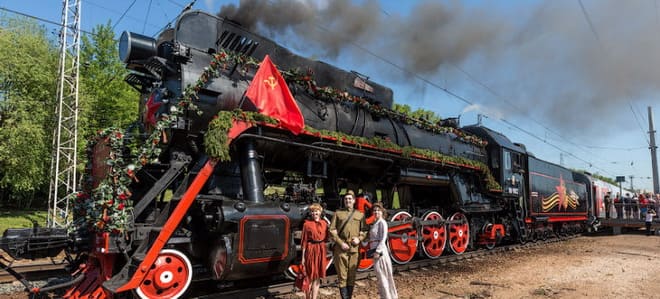
Посетить экскурсию можно бесплатно, однако требуется предварительная регистрация для получения пригласительного билета. Попасть в такой музей теоретически может каждый, на практике все не так просто. При попытке забронировать место пользователи чаще всего видят сообщение о том, что билеты закончились. Автор статьи три дня подряд пытался забронировать место для экскурсии в Чебоксарах. Безуспешно. Очевидно, желающих намного больше, чем позволяет пропускная способность музея. И, к сожалению, нет возможности для организованных групп посетить эту выставку по предварительной договоренности. Жаль, что организаторы строго ограничили время пребывания поезда на станции и количество гостей. Будем надеяться, что в следующем году учтут такой огромный спрос и расширят возможности поезда, чтобы посетить его смогли все желающие.